Guest Lectures and Teaching Assistance

Fall 2013


Spring 2013


Fall 2012


Fall 2012


Summer 2011


Spring 2011


Fall 2010


Fall 2010


Fall 2010


Fall 2010


Summer 2010

Kent State University
Teaching Assistant
(Grading/Feedback)
*See Fall 2010 Description


Kent State University
Teaching Assistant
(Grading/Feedback)
*See Fall 2010 Description


Kent State University
Teaching Assistant
(Grading/Feedback)
*See Fall 2010 Description


Kent State University
Teaching Assistant
Assisted the instructor of record in setting up the learning space in Blackboard Learn and preparing class documents (e.g., rubrics, syllabus, etc.)

Kent State University
Teaching Assistant
(Grading/Feedback)
Assisted with several lectures/discussions and provided grades and written feedback on assignments.


Kent State University
Teaching Assistant
(Grading/Feedback)
Graded and provided written feedback to 40+ students on essay-based online quizzes. 


Kent State University
Teaching Assistant 
(Grading/Feedback)
*Followed the instructor's scoring guidelines to grade and then provide extensive written feedback to 50+ students in two classes across 6 projects.

Kent State University
Teaching Assistant 
(Grading/Feedback)
Ashley graded and provided meaningful written feedback on all major projects for the class. Projects included group presentations on selected exceptionalities, observations of inclusive classrooms, and papers on assistive technology.


Kent State University
Guest Lecturer (Online)
Ashley co-instructed a class session that was held in Second Life (SL), an online virtual world wherein students and instructors use avatars to interact and learn. The class discussed service coordination, particularly the disparity in services and supports throughout the nation.

Kent State University
Guest Lecturer (F2F)
In one of her first experiences teaching at the college level, Ashley provided an interactive lecture to an undergraduate class of 100+ students in the Speech/Language Pathology program. Ashley leveraged the unique capabilities of the 'clicker' to keep track of student understanding and adjusted her teaching as needed. The PowerPoint presentation as well as a self-reflection on the session are available


Kent State University
Teaching Assistant 
(Grading/Feedback)
Assisted with grading activities in conjunction with several doctoral students.

SPED 4/53030: Applied Behavior Analysis I: Theory and Techniques

(Undergraduate/Graduate)

SPED 4/53030: Applied Behavior Analysis I: Theory and Techniques
(Undergraduate/Graduate)


SPED 4/53030: Applied Behavior Analysis I: Theory and Techniques

(Undergraduate/Graduate)


SPED 63950:    Curriculum and Intervention in Early Childhood


SPED 63958: Early Childhood Intervention Methods
(Graduate)


SPED 2300: Introduction to Exceptionalities 

(Undergraduate)


 SPED 4/53030: Applied Behavior Analysis I: Theory and Techniques
(Undergraduate/Graduate)


SPED 23000: Introduction to Exceptionalities
(Undergraduate)


Practical Applications 5-8
(Graduate)
View Reflection on Session


SPA 34104 Speech and
Language Development
(Undergraduate)
View PowerPoint
View Reflection on Session


SPED 63995:  Developing Meaningful and Legally Defensible IFSPs and IEPs for Young Children 
(Graduate)


Teaching Philosophy

Teaching is a means to an end; the act of teaching provides a mechanism by which others have the opportunity to learn. Although it is at times compelling to say one can learn to teach themselves, such a stance is a misunderstanding of the process of learning. From the beginning of recorded history to the moment you find yourself in now reading this text, people have learned by perceiving input within and around themselves. In specific, most often we learn from observing the world around us and interacting with people and things within it. As such, a teacher, instructor, professional development provider, or presenter cannot 'depart' knowledge onto others; rather, such people serve as a primary resource to support learners in their quest to increase their understanding. In the teacher-student relationship, learning and understanding is co-constructed through our interactions with one another (teacher-student; student-teacher; student-student, etc.).

Whether working with young children or adults, Ashley believes her role is to support the growth and development of those she is tasked to teach. Vygotsky proposed that learning must occur within an individual’s zone of proximal development; that is, whether young or old, novice or experienced, students begin to explore a topic with a certain amount of knowledge. Therefore, each learner’s potential to acquire specific skill sets in a specified amount of time varies depending upon what they already know combined with their unique learning characteristics.

To truly scaffold an individual's learning, intentional planning or forethought of content-specific information is necessary.  Such intentionality should include determining learners' interests, preferences, learning style, background, and experience to identify the baseline of each group and student. This provides the individual tasked with teaching the means to serve as a conduit for each individual students' learning journey.Although remaining flexible in instruction is necessary in order to best respond to student needs and understanding, it is necessary to be mindful of learning objectives and have a framework by which you plan to meet the needs of all learners. 

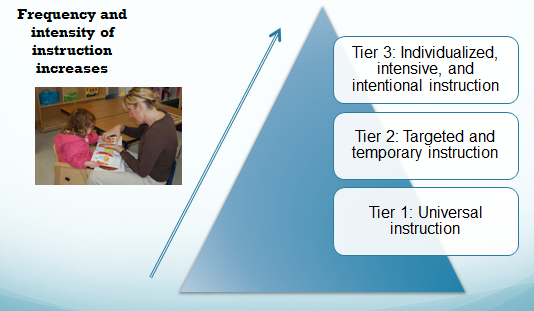
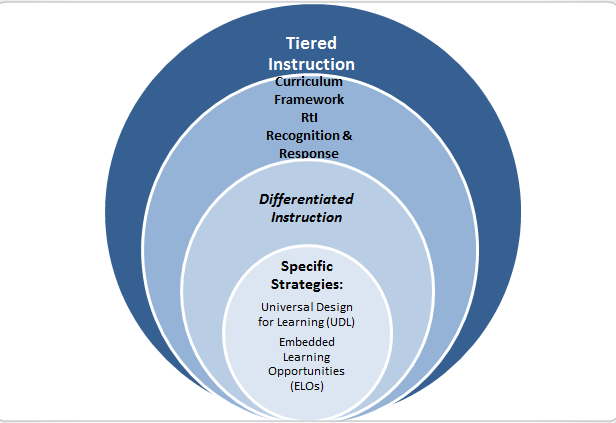
Further, using the principles of universal design for learning (UDL) is applicable whether working with groups of children or adults. Such an approach provides the means for multiple types of learners to access the material and engage in sense-making. In a college course, instructors need not necessarily have all the bells and whistles and untold numbers of different ways of presenting course materials; in fact, less is more. The key is to provide multiple means of presentation, the minimal amount necessary to provide appropriate options for all students. Differentiating instruction, or the use of a tiered model of instruction and feedback, is also warranted. When one tiers instruction as well, they are then able to provide more targeted feedback and guidance to those that are not ‘responding’ to universal (Tier 1) design. 


Spring 2014
(expected)


Fall 2013


Summer 2013


Summer 2013


Spring 2013


Summer 2012


Spring 2012


Spring 2011


Spring 2011


Fall 2010

Courses Taught & Supervision Provided


Kent State University
Instructor (F2F)
In the process of being revised to better support students in learning the administration of specific widely used tools in Ohio. 


Kent State University
Instructor and Supervisor (F2F)
Seminar discussions/interactive lectures as well as supervision of students on location at practicum placements/employment. 


Kent State University
Instructor (Online)
Similar scope and sequence to the 2012 course, but with updated content (see description for the 2012 class). Asynchronous with on-demand recordings and learning modules. Course Management System: Blackboard Learn. Extensive written feedback provided for all class activities and facilitated discussion. 


Kent State University
Co-Instructor 
(Hybrid; F2F & Online)
The class focused on identifying and planning for the use of evidence-based practices. Students utilized the intentional planning sequences weekly to demonstrate their learning, in addition to projects, quizzes, and a final exam. All exam material was co-created by Ashley and her co-instructor. Online components included Blackboard Learn and Adobe Connect.


Kent State University
Co-Instructor (F2F)
The class engaged in a number of activities designed to build students' confidence and competence  in using a wide variety of assessments as well as critically examining the reliability and validity of assessment measures. While Ashley taught in person, her colleague was based in Iowa and thus the class utilized a variety of technologies to communicate synchronously. Based on class feedback to an evaluation measure she created (questions were carefully worded to capture  both positive and critical feedback), Ashley is re-organizing the course for Spring 2014. Please see Ashley's reflection for additional information.


Kent State University
Co-Instructor (Online)
The course provided students with a comprehensive background of the federal law as it relates to the Individuals with Disabilities Education Act (IDEA)- in particular those sections relevant to the development of IEPs and IFSPs- and then narrowed students focus to the laws, rules, and regulations that govern IEP/IFSP development in their home states (there were students from Ohio and Iowa in the course). In addition, students learned about best practices in IEP/IFSP development and practiced creating high-quality and meaningful IEPs/IFSPs that adhere to both the law and best practice.
Asynchronous with on-demand recordings and learning modules. Course Management System: Blackboard Learn. Extensive written feedback provided for all class activities and facilitated discussion. 


Kent State University
Instructor (F2F)
The practicum seminar is designed to provide preservice-teachers with a student teaching experience that is linked to ongoing seminar discussions and projects that bring research and theory into student practice. Working from a course framework developed for the Kent State ECIS program by Dr. Sanna Harjusola-Webb, Ashley updated the content and developed templates that would assist students in functionally completing activities. The templates were received with gratitude, and students did a phenomenal job in carrying out and sharing the action research they completed. 


Kent State University
Co-Supervisor (F2F)

Supervised two practicum students with a colleague.


Kent State University
Co-Instructor (F2F)

The course provided a general overview of common exceptionalities, whether physical, intellectual, developmental, or otherwise. Students were required to engage in observations and other activities that were designed to measure the extent to which they were able to use their learning in a practical manner related to educating students.


Cleveland State University
Instructor (Online)
This class was organized to provide students with an introduction to child development, including identifying typical vs. atypical developmental patterns. Students were challenged to explore the link between assessment items on common early childhood measures and the general developmental trajectory. Additionally, students engaged in assessment to learn how to tie their learning to practice.


SPED 63957:  Assessment and Evaluation in Early Childhood Services 
(Graduate)


SPED 63992:  Advanced Practicum Seminar
(Graduate)
View Syllabus
View Handbook 
(Refer to Spring 2012 documents for additional materials being used that are being modified as needed) 


SPED 63995:  Developing Meaningful and Legally Defensible IFSPs and IEPs for Young Children 
(Graduate)
Personal emailed feedback from student: 
"I want to thank you for all your help this summer with both my SPED classes. I learned a great deal from you.I hope someday to be as knowledgeable as you are. I appreciate all the extra time you spent further explaining details to me and sending me resource links. I hope our paths cross again. Enjoy the rest of your summer!"


SPED 63958: Early Childhood Intervention Methods
(Graduate)
Personal emailed feedback from student:
"Hi Michelle and Ashley,
I just wanted to say thank you for a great class! Also thanks for always giving such detailed feedback, I loved reading your comments and opinions.
Have a great rest of the summer!"


SPED 63957:  Assessment and Evaluation in Early Childhood Services 
(Graduate)
View Syllabus   
View Assignment Descriptions
View Student Mid-term Evaluations

View Course Calendar

View Reflection on Course


SPED 63995: Developing Meaningful and Legally Defensible IFSPs and IEPs for Young Children 
(Graduate)
View Syllabus

View Course Calendar


SPED 63992:  Advanced Practicum Seminar
(Graduate)

View Student Evaluation Summary

View Syllabus
View Data and Graph Template
View Poster Template
View Student Poster Invite Flyer 

View Literature Table Template


SPED 63992:  Advanced Practicum Seminar
(Graduate)


SPED 23000: Introduction to Exceptionalities
(Undergraduate)
View Syllabus
Written Directions for Screencasts
Written Directions for Electronic Posters
View Screencast Sample 1 about Creating Electronic Posters
View Screencast Sample 2 about Creating Electronic Posters


EDC 501 Child Development 
(Graduate)
View Syllabus 
View Course Policies
View Course Calendar
View Course Assignments
View Group Webquest Rubric
View Group Webquest Framework and Guidance

View Teaching Reflection

This free website was made using Yola.

No HTML skills required. Build your website in minutes.

Go to www.yola.com and sign up today!

Make a free website with Yola